“Life is like an RPG” is a quote I often think of, and it is also true in the corporate world, where a company’s story begins as a start-up and evolves into a big name in the industry.
Most rookie CEOs believe their first move should be to launch the product.
Veteran CEOs know the real first move is IP positioning.
In IP-heavy industries, you don’t get rewarded for moving fast—you get rewarded for moving smart.
Before you reveal your product, you need to secure the intellectual property landscape around it.
Here are three opening moves CEOs use to win the long game.
Three Chess Moves for CEOs Entering IP-heavy Markets:
Move 1 – Hunt White Space Before You Move
Before we start implementing the idea, it is essential to plan a strategy and understand the scene we are entering, especially regarding the design, technology, and manufacturing processes used for our product. Here are some things that we can do:
- Patent Landscape Analysis: Map all existing patents for the category (e.g., articulation joints for figures and other mechanisms for toys, animation production tools, procedures of game design).
- Trademark Availability: Perform trademark availability before branding. There is a chance that what you are about to trademark may already exist.
Example: Before launching Lego Mindstorms, Lego’s lawyers mapped its robotics patents to avoid infringing Sony/Nintendo’s patents, then filed its own robotics patents in the gaps.
Insight: Don’t build on contested ground. Own the white space before you even enter the board.
Move 2 – Licence Before You Invent
There are times when a company can license its assets to other companies to boost its finances. This tactic is used both as a last resort in case of bankruptcy and as a helpful tool in forming future corporate relationships.
Example:
- Marvel Studios licensed Spider-Man to Sony and X-Men to Fox for TV and Movie production, also to help recover from past losses.
- Sports franchises like F1 and FIFA are being granted exclusive licenses to video game companies, giving them the right to release video games under their own brand.
Insight: Strategic licensing is like raising non-dilutive capital. You monetize IP without giving up ownership.
Move 3 – Build “What We Own Early”
File proprietary patents, trademarks, or design rights on something unique—even before the product is public.
Example: When Nintendo launched Pokémon, they not only patented gameplay mechanics but also the character designs, names, and even artwork, which are used in other parts of the franchise, like the trading card game. That ensured copycats could never replicate the format exactly.
Insight: Even minor quirks—ratios, sounds, packaging—can become uncopyable assets if protected early.
Story: The Safe Entry Play
Diecast Model collecting is one of the biggest hobbies in the world, spanning a wide range of scales —from the smallest (1:64) to the largest (1:18) —and featuring a variety of brands making dedicated models based on manufacturers, car classes, and even original and creative designs.
This is the story of how one man left one of the biggest diecast manufacturers to start a boutique brand featuring unique diecast models celebrating a specific part of car culture.
Jun Imai began his journey into diecast model design when he joined Hot Wheels in 2004, starting with creating unique in-house “originals.” Like Covelight and Rocket Box, to real-life licensed cars like the ’07 Ford Mustang and the Datsun 510.
Though his main domain in his line-up of castings consisted of classic Muscle cars and Original designs, he was well known for his castings based on Japanese cars; he even made castings based on the actual vehicles he owned, like the ’71 Datsun 510 Bluebird Wagon and Nissan Fairlady Z, which are also one of the most popular licensed castings till today.
2018 was the year when Jun left Hot Wheels. After that, he started Kaido House, a brand he founded, selling automotive enthusiast merchandise, which has now evolved into a boutique line of high-end, exclusive diecast models featuring unique designs inspired by aftermarket car culture, collaborating with TSM Model, the parent company of another high-end diecast manufacturer, Mini GT.
Now, although his designs sell under Mini GT, he still has a hand in model design, features, etc. Each Kaido House model is unique and bespoke compared to a standard Mini GT model, featuring opening parts like doors and a hood, an original bodykit design, and a livery design featuring sponsors from various approved manufacturers, all of which is also patented and trademarked beforehand.
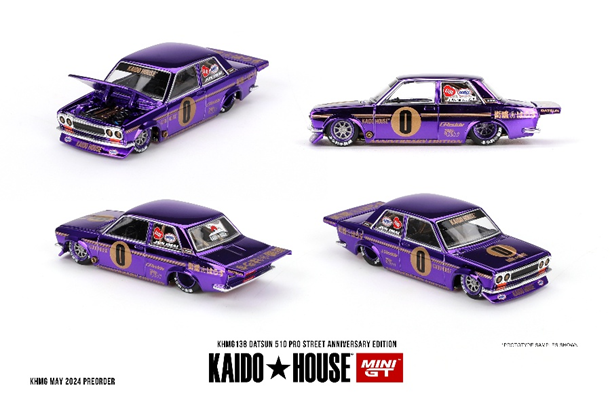

Images of Mini GT Kaido House KHMG138 Datsun 510 Pro Street Anniversary Edition
Through this story, we can learn that the smart use of IP can help attract big names to collaborate and build long-term relationships. Kaido House, when Jun worked at Hot Wheels, was a fictional brand on their cars, but today it’s a big name that’s become synonymous with Jun himself and gives his designs a unique reputation in the market.
Conclusion
The corporate world is one big chessboard where every move can impact your operations. Veteran executives play chess with IP by
- Mapping their White Space
- Licensing Strategically
- Owning what only they own
With these three moves, you can get ahead in the market where product alone isn’t enough.
Leave a Reply