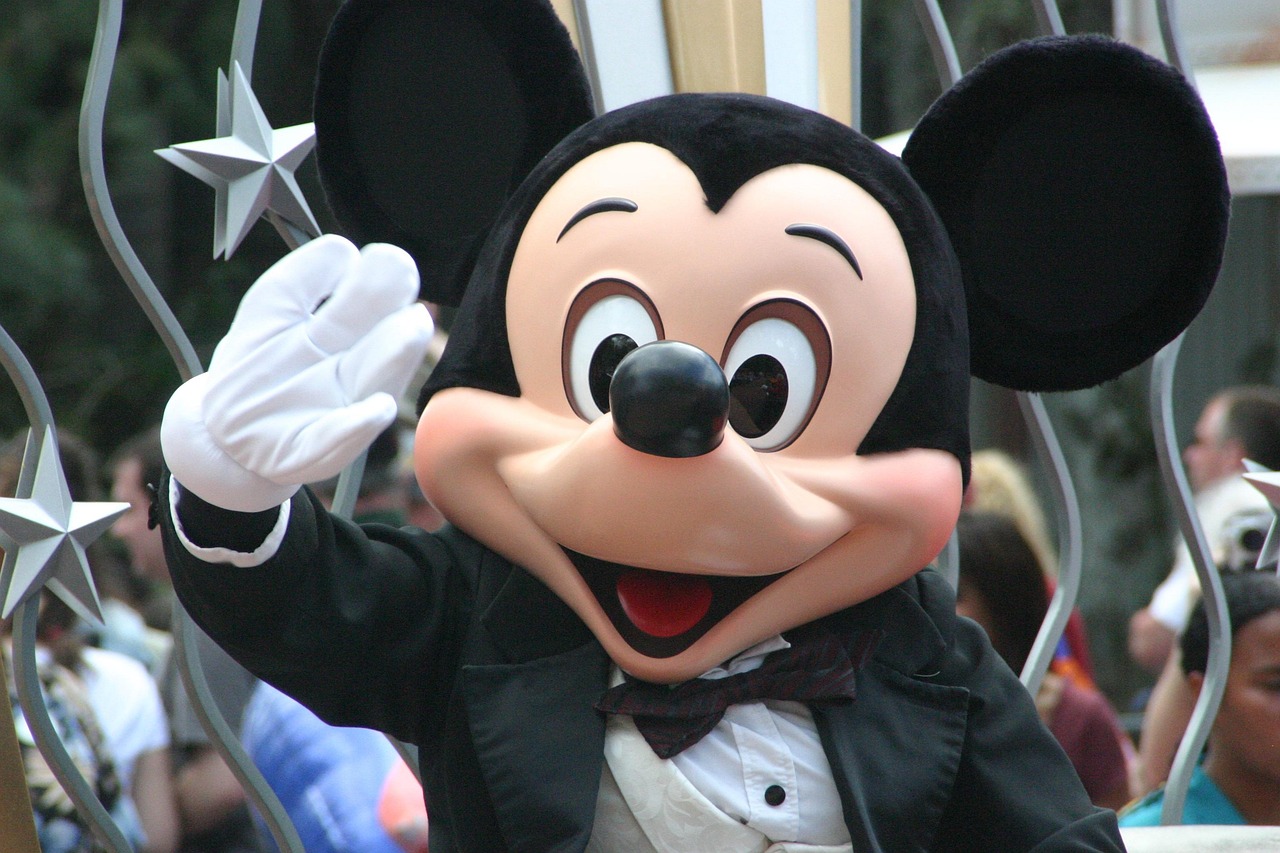
Mickey Mouse is the face of one of the world’s largest entertainment giants, Disney. He has lived a pretty long life, from getting accolades like the Oscars to spreading laughs all around the world with his adventures, but did you know Mickey Mouse is not only a cartoon but one of the many early origins that changed the landscape for both copyright laws and IP in general, but how the long journey of this beloved character will help the tech executives in understanding IP. That’s what we will learn in this article.
“It all starts with a mouse.”
‘Before the mouse, there was a rabbit.’
Before Walt Disney became the iconic figure he is today, he was a small cartoonist working alongside his friend Ub Iwerks and a team of passionate animators at Universal Studios, where his first character was born.
His name is ‘Oswald the Lucky Rabbit’, a rabbit with blue shorts who has starred in over 26 shorts.
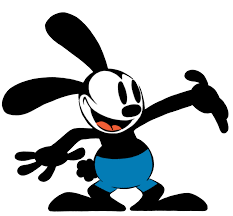
But one moment changed everything. Since Walt and his group were working with Universal, he didn’t have the rights to Oswald.
He also faced betrayal when he found out that one of the executives was secretly recruiting artists from his team to his side, cutting out Walt’s earnings from the shorts. He quit Universal together with Ub in 1928. While returning from New York, Walt had already planned to create a new character and decided, from that day on, to protect what he was making and would continue to do so.
So, Ub and Walt got to work, looking back on how he worked on Oswald, Walt already had the idea for everything: the look, the personality, etc. For what animal to choose, he chose a mouse because he was inspired by a mouse he befriended when he worked at Laugh-o-Gram Studios. Ub was done with the design, which was inspired by characters like Felix the Cat and even Oswald. Walt decided to name him ‘Mortimer’, but his wife suggested Mickey, and thus Mickey Mouse was born.
Why does this matter to Tech Executives?
Mickey Mouse is not only a cartoon character but also one of the most profitable IP assets in history. Disney turned him into a century-long cash machine using every IP tool in the book: copyright, trademark, design rights, and brand architecture.
For Tech executives, Mickey’s journey can help them understand how to strategically use IP to extract value over decades by treating it not as just paperwork but as a strategic moat.
1928 – The Birth of a Character (and a copyright clock)
Mickey made his debut in the short called ‘Plane Crazy’, where he decides to become an aviator. Back then, television was still in its early stages of development, so these shorts were shown between intervals at theatres. However, Disney couldn’t find a distributor for Mickey’s early shorts.
But “Steamboat Willie” was where Mickey started to make a name, styled after Buster Keaton’s film Steamboat Bill Jr. It was an instant hit and was picked up by distributors and finally released on 18 November 1928 which also ended up being Mickey’s birthday since despite being the third short created by Walt, Steamboat Willie ended up being the proper debut for him.
Disney immediately filed a copyright, which was granted the then-current 56-year protection term. They also released merchandise from day one. Mickey was everywhere, from magazines and newspapers to lunch boxes, toys, watches, etc.
Business lesson: Register IP early and build monetization channels in parallel.
Locking down the brand domain, trademarks, code licenses, etc., before launching your software/hardware can be a good parallel for tech companies. For example, electronic and video game companies often lock down domains, trademarks, etc. These may include the product’s name, materials/processes used, licenses, etc.
1976 – The First Expiry Looms
In 1976, the copyright term was set to expire, so Disney lobbied the US Congress to extend it. The US Copyright Act of 1976 came into effect, extending the term for works copyrighted before 1978 from 28 years to 47 years, resulting in a total term of 75 years. With this, Disney managed to protect Mickey for a long time.
Business lesson: Don’t panic when the key assets age. Use the law as a lever to extend control over them.
For example, extending API exclusivity through regulatory lobbying and platform policies.
1998 – The Mickey Mouse Protection Act
Disney again lobbied Congress to extend the term as the copyright was approaching expiration in 1998, leading to the formation of the Sonny Bono Copyright Term Extension Act, which extended the term for works copyrighted before 1978 from 47 years to 67 years, lengthening it to 95 years. This act also earned the nickname “The Mickey Mouse Protection Act” from many due to Disney’s actions, and it became a case of influencing law to maintain control over a single property’s earning power.
Business lesson: Don’t treat expiration as inevitable; fight strategically to prolong and reframe value.
For example, companies are working to extend their proprietary standards or lobby for patent windows for emerging technologies.
2000s – Multi-Layered IP Shielding
Mickey was still thriving well during the 2000s. At the same time, competitors brought their own ‘mascots’ to the scene. During this, Disney discovered two problems: first, that their current format of shows featuring Mickey was not appealing to the audience, and second, that copyright isn’t infinite; it is bound to expire sometime.
To counter these problems, Disney did the following:
- Created new variants in different platforms to reset the copyright clocks. Ranging from TV shows like House of Mouse and Mickey Mouse Clubhouse, Movies like The Three Musketeers, and video games like Kingdom Hearts and Epic Mickey.
- Filed Trademarks for Mickey’s character elements like silhouettes, Voice, Gloves, & Ears, which also include many revisions and redesigns in Mickey’s character design over the years.
- Used design patents for merchandise, toys, and theme parks.
IP layering strategy
Copyright → Trademark → Design Patent → Trade Dress
Business lesson: Use layered IP like stacked defences. If one layer expires, the other protects.
For example. Having copyrights on code, trademarks on brand, patents on UI/UX, processes of the software/hardware, technologies used in production, and trade secrets in data pipelines.
2024 – Steamboat Willie enters the Public Domain
On the day of 1st January 2024. The debut movie, which made Mickey and Disney what they are today, finally entered the public domain, but what does this mean for ‘other’ works related to Mickey Mouse? Before that, it’s best to understand what the public domain is. Public Domain is a category where works that are not copyrighted enter, and these can be accessed by the public. These may involve books, movies, TV shows, music, and even advertisements. This helps creativity, inspiration, and innovation, as artists and other creative individuals can use it to create their art.
However, the situation is a little complicated in the case of Mickey. Steamboat Willie may have gotten the pass, but that isn’t the case with other iterations of Mickey. Like the modern iterations and their elements will still be with Disney. A work may enter the public domain and can be accessed; however, due to trademark, it still can be under the scrutiny of the companies as long as the intent comes under fair use, in simple words, as long as the work is not under commercial use, the work will be safe for the person accessing it.
Disney has stated that it will take action if the work is used commercially without authorization. Mickey is still prominent across many platforms today, including streaming services like Disney+, merchandise, toys, and video games.
Business lesson: Public Domain isn’t a free-for-all, Trademark can hold the castle even when the gate is open.
For example. Even if the core code becomes open source, the trademark, branding, and proprietary extensions can keep competitors at bay.
Mickey’s IP Timeline at a glance
| Year | IP Move |
| 1928 | Copyright Filed |
| 1976 | Copyright extended (56 → Life+50) |
| 1998 | Copyright extended again (Life+70, Corp: 95 years) |
| 2000 | Trademark stacking + Modern variants |
| 2024 | Steamboat Willie enters the Public Domain – But modern Mickey stays protected |
Result: Mickey still generates >$5B/year in licensing, media, and merchandise – 96 years after creation.
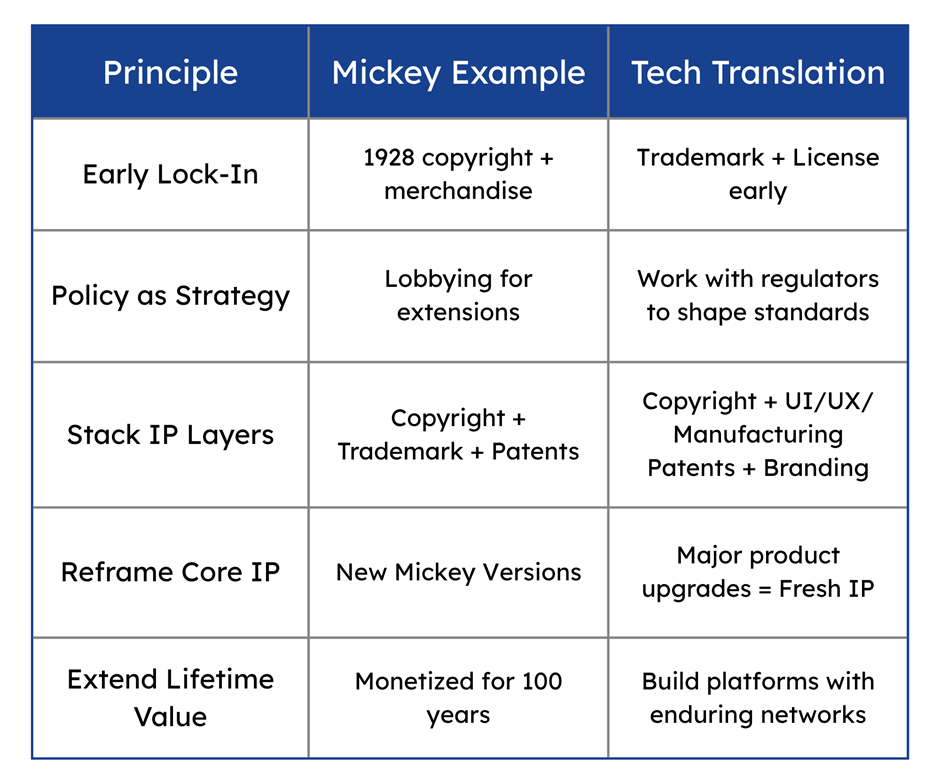
Business Model Takeaways for Tech Executives
Conclusion
Mickey walked a long way, and today he is still enjoyed by many people all around the world. Disney never gave up on Mickey, but they also reunited his brother, Oswald, back in 2006. Disney retained him in exchange for Al Michaels, a sports personality, to NBC, and even though Steamboat Willie entered the public domain, all other content is also accessible through channels like Disney+. That’s not all, we were able to understand how many ways IPs can be used and the influence they have on society. Disney didn’t just create a character – they helped create a system for extracting, protecting, and compounding value from IP for generations.
In the tech world itself, IP is an essential element for a company to survive; it can be used in many ways, as explained, for example, protecting technological processes away from competitors, and controlling where and how the IP can be used through copyrights and trademarks to prevent unauthorised sales and misinformation.
If you are a tech leader building products, brands, or a platform, think once: Are you protecting your assets for the next release or for the next century?
Leave a Reply